
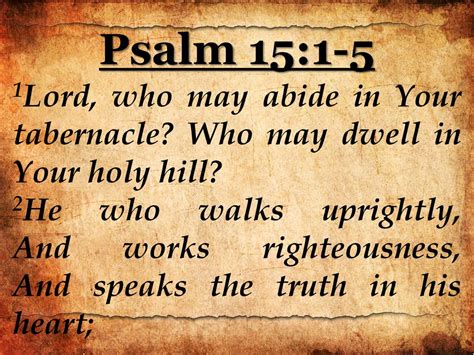
This morning I chose to look at Psalm 15:1-5. (1) LORD, who may abide in Your tabernacle? Who may dwell in Your holy hill? (2) He who walks uprightly, And works righteousness, And speaks the truth in his heart; (3) He who does not backbite with his tongue, Nor does evil to his neighbor, Nor does he take up a reproach against his friend; (4) In whose eyes a vile person is despised, But he honors those who fear the LORD; He who swears to his own hurt and does not change; (5) He who does not put out his money at usury, Nor does he take a bribe against the innocent. He who does these things shall never be moved.
The phrase “Who may DWELL”? The study summation says. . . the Hebrew of the phrase “who shall dwell” does not suggest “living in,” but rather “visiting with”—that is, being acceptable to come into God’s presence.
I have to take issue with this train of thought by the Berean, John W. Ritenbaugh.
I am a word study person. The word for DWELL in this verse is:
shâkan, shaw-kan’; a primitive root (apparently akin (by transmission) to H7901 through the idea of lodging; compare H5531, H7925); to reside or permanently stay (literally or figuratively):—abide, continue, (cause to, make to) dwell(-er), have habitation, inhabit, lay, place, (cause to) remain, rest, set (up).
The word SHAKAN does not indicate the idea of visiting. It says without a doubt that the DWELL here is indicative of residing or permanently staying. Not a VISIT mentioned anywhere in the definition.
The question at hand asks “Who may dwell”. The rest of the verses tell who they are. There is a people that will meet this criteria and go into and permanently stay in God’s presence. Enoch was one such person of human origin who did.
Gen 5:24 – And Enoch walked with God: and he was not; for God took him.
I firmly believe we that follow the guidelines in the text of “Who will” will in fact go to dwell permanently. Not just visit.


 Livin' Small